
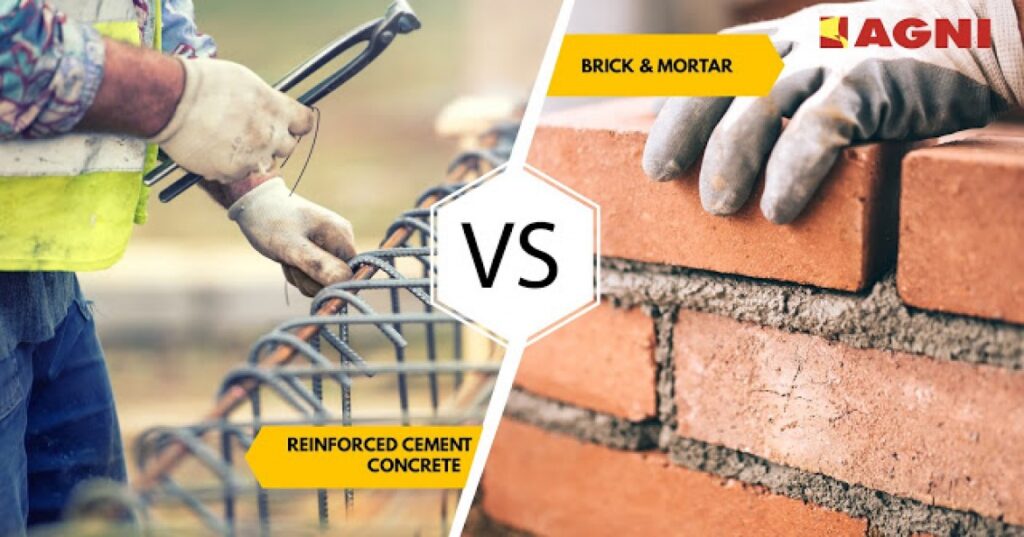
In the 21st century, RCC construction (Reinforced Cement Concrete) has become the gold standard in structural engineering, replacing traditional brick-and-mortar buildings for most modern applications. RCC combines the compressive strength of concrete with the tensile strength of TMT steel bars, resulting in unmatched durability and design flexibility.
Unlike brick masonry—which uses bricks joined by a mixture of cement, sand, and water—RCC construction integrates steel reinforcement bars (rebars) within concrete, enhancing the structural performance dramatically.
What Is an RCC Building?
An RCC building (Reinforced Cement Concrete Building) is a structure in which concrete and steel reinforcement bars work together to provide exceptional strength and durability. Concrete effectively handles compressive forces, while TMT steel bars resist tensile stresses, making RCC buildings suitable for residential homes, commercial complexes, industrial facilities, bridges, hospitals, schools, and high-rise towers.
Today, almost every modern construction project relies on RCC technology because it offers better structural stability, safety, and longevity compared to conventional brick masonry buildings.
Main Components of an RCC Building
Every RCC building consists of several structural components that work together to distribute loads safely.
RCC Foundation
Transfers the entire building load to the ground while ensuring structural stability.
RCC Columns
Columns act as the primary vertical support system, carrying loads from slabs and beams to the foundation.
RCC Beams
Beams connect columns and transfer loads efficiently throughout the structure.
RCC Slabs
Concrete slabs form the floors and roof while distributing loads evenly.
TMT Steel Reinforcement
High-strength TMT bars improve tensile strength, ductility, and earthquake resistance.
Concrete
A mixture of cement, sand, aggregates, and water binds the reinforcement together to create a strong structural framework.
RCC Construction vs Brick and Mortar Construction
Traditional brick-and-mortar buildings rely on load-bearing walls to support the structure. While suitable for small buildings, brick masonry has several limitations when compared to RCC construction.
An RCC building uses reinforced concrete columns and beams as its structural framework, allowing walls to act only as partitions. This significantly improves strength, flexibility, and construction efficiency.
Advantages of RCC Buildings Over Brick Buildings
1. Superior Load-Bearing Capacity
The biggest advantage of an RCC building is its outstanding load-bearing capability.
Steel-reinforced concrete enables buildings to support:
- Multiple floors
- Heavy machinery
- Large commercial spaces
- High occupancy loads
Premium Fe 550D TMT bars provide excellent tensile strength and ductility, making RCC structures highly resistant to structural stress.
Unlike RCC structures, brick masonry often develops cracks and requires repairs within a few years due to settlement, moisture, or excessive loading.
2. Greater Design Flexibility
Since RCC columns carry the structural load, architects enjoy complete freedom in planning modern layouts.
Benefits include:
- Open floor plans
- Larger halls
- Spacious living rooms
- Modern architectural designs
- Flexible interior modifications
Brick buildings depend on load-bearing walls, restricting design possibilities.
3. Stronger and More Efficient Foundations
RCC foundations provide better load distribution with comparatively less excavation.
Advantages include:
- Better soil bonding
- Improved structural stability
- Reduced settlement
- Longer foundation life
Brick foundations often require deeper excavation and may weaken over time due to moisture exposure.
4. Long-Term Cost Savings
Although RCC construction may require a slightly higher initial investment, it offers significant long-term savings through:
- Lower maintenance costs
- Fewer structural repairs
- Longer service life
- Reduced renovation expenses
For multi-storey buildings, RCC becomes far more economical than conventional brick construction.
5. Excellent Earthquake Resistance
India falls under multiple seismic zones, making earthquake-resistant construction increasingly important.
RCC buildings perform exceptionally well because reinforced steel bars absorb and redistribute seismic forces.
High-quality Fe 550D TMT bars provide:
- High ductility
- Better flexibility
- Reduced structural damage
- Improved occupant safety
6. Fire and Weather Resistance
An RCC building offers superior protection against:
- Fire
- Heavy rainfall
- Cyclones
- Strong winds
- Floods
Properly designed RCC structures maintain their integrity even under harsh environmental conditions.
7. Superior Corrosion Resistance
Modern RCC construction uses corrosion-resistant (CRS) TMT bars that significantly improve durability in coastal and humid regions.
Benefits include:
- Reduced rust formation
- Longer structural lifespan
- Lower maintenance costs
- Improved durability in aggressive environments
8. Ideal for High-Rise Construction
From residential towers to airports and metro stations, RCC construction has become the backbone of modern infrastructure.
Applications include:
- High-rise apartments
- Shopping malls
- Hotels
- Hospitals
- Flyovers
- Bridges
- Industrial plants
Brick masonry simply cannot support such large-scale structures efficiently.
9. Sustainable and Energy Efficient
RCC buildings are highly compatible with sustainable construction practices.
Advantages include:
- Reduced material wastage
- Precast construction
- Modular construction
- Green building certifications
- Recyclable steel reinforcement
These features make RCC construction environmentally responsible and future-ready.
RCC Building Construction Process
The construction of an RCC building follows a systematic engineering process.
- Site survey and soil testing
- Structural design and planning
- Excavation
- Foundation construction
- Placement of TMT steel reinforcement
- Formwork installation
- Concrete pouring
- Concrete curing
- Column and beam construction
- Slab casting
- Masonry work
- Finishing and quality inspection
Each stage plays a critical role in ensuring structural safety and long-term durability.
Applications of RCC Buildings
Today, RCC buildings are used in nearly every construction sector.
Common applications include:
- Independent houses
- Villas
- Apartments
- Office buildings
- Shopping complexes
- Educational institutions
- Hospitals
- Hotels
- Warehouses
- Factories
- Bridges
- Flyovers
- Metro stations
- Water tanks
- Airports
The versatility of RCC makes it the preferred construction method for projects of every scale.
RCC Building vs Load-Bearing Building
| Feature | RCC Building | Load-Bearing Building |
|---|---|---|
| Structural Strength | Excellent | Moderate |
| Maximum Floors | High-rise construction | Usually 2–3 floors |
| Earthquake Resistance | High | Limited |
| Design Flexibility | Excellent | Restricted |
| Construction Speed | Faster | Slower |
| Maintenance | Low | Higher |
| Lifespan | 75–100+ years | Around 40–60 years |
| Future Expansion | Easy | Difficult |
How Long Does an RCC Building Last?
A properly designed RCC building can easily last 75 to 100 years or more when constructed using premium-quality materials and maintained regularly.
Its lifespan depends on:
- Concrete quality
- Grade of TMT bars
- Proper curing
- Engineering design
- Environmental conditions
- Routine maintenance
Using corrosion-resistant Fe 550D TMT bars further extends the building’s service life.
Why TMT Bars Are Essential for an RCC Building
The quality of reinforcement steel determines the strength of any RCC building.
Premium TMT bars provide:
- Superior tensile strength
- Excellent ductility
- Better bonding with concrete
- Earthquake resistance
- Fire resistance
- Corrosion resistance
- Longer structural life
Choosing certified TMT bars ensures the safety and durability of the entire structure.
Choosing the Right TMT Bars for RCC Construction
When selecting TMT bars for RCC buildings, consider the following factors:
- BIS certification
- Grade (Fe 500D or Fe 550D)
- High tensile strength
- Earthquake resistance
- Corrosion resistance
- Weldability
- Uniform rib pattern
- Reliable manufacturer
High-quality reinforcement significantly improves the performance and longevity of RCC structures.
RCC Is the Future of Construction
As India’s urban landscape continues to expand, RCC buildings have emerged as the safest, strongest, and most cost-effective construction solution.
Compared to conventional brick buildings, RCC offers:
- Higher structural strength
- Better disaster resistance
- Longer lifespan
- Lower maintenance costs
- Modern architectural flexibility
- Sustainable construction practices
- Better return on investment
Whether constructing a family home, commercial building, or large infrastructure project, RCC remains the preferred choice for engineers and builders worldwide.
Powered by Agni Steels
At Agni Steels, we proudly contribute to India’s modern infrastructure by manufacturing premium-quality Fe 550D TMT Bars and Corrosion Resistant Steel (CRS) rebars designed for superior RCC construction.
Our TMT bars deliver:
- Superior bonding with concrete
- High tensile strength
- Excellent ductility
- Earthquake resistance
- Fire resistance
- Corrosion protection
- Long-lasting structural performance
With decades of trust across South India, Agni Steels continues to strengthen homes, commercial buildings, and infrastructure projects by providing steel solutions that meet the highest quality standards.
Also Read: RCC Construction Techniques That Every Builder Should Know
Frequently Asked Questions
What is an RCC building?
An RCC building is a structure constructed using reinforced cement concrete, where steel reinforcement bars are embedded inside concrete to provide superior strength, durability, and structural stability.
Why is RCC better than brick construction?
RCC buildings offer higher load-bearing capacity, better earthquake resistance, longer lifespan, lower maintenance, and greater architectural flexibility than traditional brick masonry structures.
Which TMT bars are best for RCC buildings?
High-quality Fe 550D TMT bars with excellent ductility and corrosion resistance are considered ideal for RCC buildings because they provide superior structural performance.
How long does an RCC building last?
With proper construction practices and quality materials, an RCC building can last 75 to 100 years or even longer.
Why are TMT bars used in RCC construction?
TMT bars improve the tensile strength of concrete, increase earthquake resistance, enhance durability, and ensure the structural safety of RCC buildings.